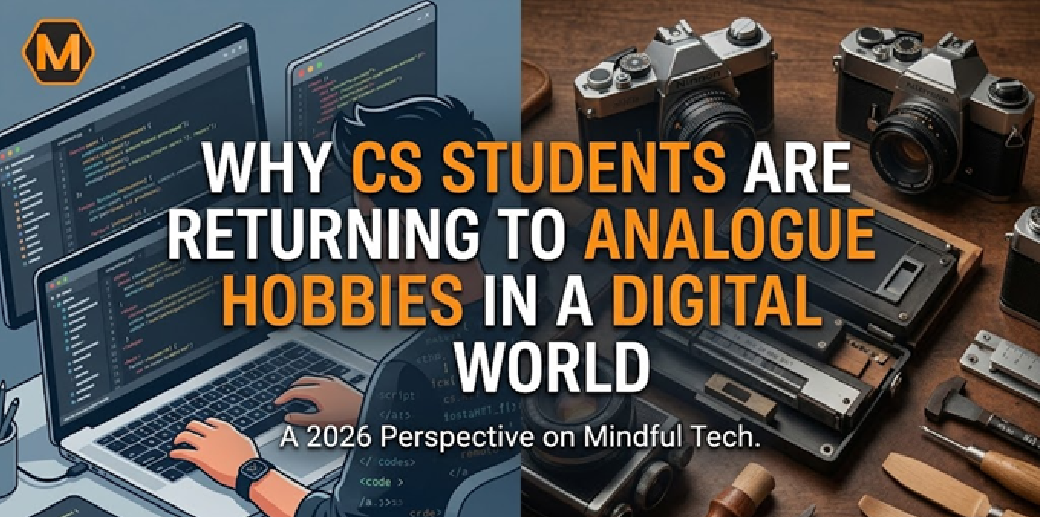
The image of a computer science student is often a cliché: a figure hunched over a backlit keyboard in a dark room, fueled by caffeine and the blue light of three different monitors. For decades, the path to mastery in the digital arts was thought to require total immersion in the digital world. However, in 2026, a quiet revolution is happening on campuses from Silicon Valley to Singapore. The very people building our digital future are increasingly spending their free time far away from screens. They are turning to tactile, physical, and “slow” activities—analogue hobbies that offer a necessary counterweight to the high-velocity world of code.
This shift isn’t just about nostalgia; it is a survival mechanism against cognitive overload. As the complexity of modern software grows, the mental stamina required to debug deep neural networks or optimize distributed systems becomes a finite resource. To manage this pressure, many high-performing students have realized they cannot be “on” 2026’s digital grid at all times. By seeking professional Computer Science Assignment Help from myassignmenthelp, these students are successfully offloading the mechanical burden of documentation and repetitive research. This strategic delegation allows them to reclaim the mental “white space” needed to engage in hobbies that actually restore their neurological health.
The Science of “Digital De-escalation”
The human brain, even one trained in complex logic, is not designed for 16 hours of continuous digital stimulation. “Digital de-escalation” is the practice of deliberately lowering the brain’s arousal levels by engaging in activities that involve different senses. When a student switches from a terminal window to a woodworking bench or a physical sketchbook, they engage their motor skills and spatial awareness in a way that coding never can.
This sensory shift triggers a “neurological reset.” While coding is a high-beta wave activity—focused, intense, and often stressful—analogue hobbies encourage alpha and theta waves, which are associated with relaxation and creative insight. This is why many programmers report having their best “aha!” moments not while staring at the screen, but while gardening, baking sourdough, or restoring vintage film cameras. The brain requires these periods of “diffuse mode” thinking to synthesize complex information gathered during “focused mode” study sessions.
Comparing the Cognitive Impact
To understand why this transition is happening, we must look at how digital tasks differ from analogue ones in terms of biological and psychological demands.
| Feature | Digital Tasks (Coding/Labs) | Analogue Hobbies (Crafting/Sports) |
| Primary Brain State | Focused Mode (Beta Waves) | Diffuse Mode (Alpha/Theta Waves) |
| Feedback Loop | Abstract/Virtual | Physical/Tactile |
| Error Handling | Instant “Undo” / High Stress | Permanent / Teaches Patience |
| Sensory Input | Limited (Sight/Sound) | Multi-sensory (Touch/Smell/Depth) |
| Long-term Benefit | Skill Acquisition | Cognitive Longevity & Burnout Prevention |
Tactile Feedback in a Virtual Career
For a CS student, most of their “work” is invisible. You can spend twelve hours writing a script, and at the end of the day, you have nothing to physically touch. This lack of tangible output can lead to a sense of detachment or “existential fatigue,” a common precursor to burnout. Analogue hobbies solve this by providing immediate, physical feedback.
- Mechanical Keyboard Modding: Ironically, even their gear is going analogue. Building custom mechanical keyboards allows students to touch the hardware they usually take for granted, turning a tool into a personalized artifact.
- Film Photography: Unlike the infinite, disposable nature of digital photos, film photography requires patience, chemistry, and a physical limit of 24 or 36 frames. It forces a “one-shot” mentality that improves focus.
- Pottery and Ceramics: The high-stakes environment of “version control” is replaced by the permanent, physical reality of clay. There is no Ctrl+Z on a pottery wheel.
By mastering a physical craft, students regain a sense of agency that can feel lost in the abstract world of cloud computing and virtual machines. They are moving from being “users” of the world to “makers” of the physical environment.
Managing the “Academic Bottleneck”
The primary barrier to this analogue lifestyle is, of course, time. The modern CS curriculum is denser than ever, with students expected to master everything from assembly language to the ethics of Generative AI. When the workload hits a breaking point, the first thing to be sacrificed is usually the very “offline time” that keeps a student sane.
To prevent burnout, the smartest students in 2026 treat their time like a professional resource. When a project becomes a “bottleneck” that threatens their mental health, they look for an assignment helper online to assist with the structural and time-consuming parts of their coursework. This isn’t about avoiding work; it’s about optimizing the human “processor.” If a student spends 40 hours a week on repetitive documentation, they have zero hours left for the high-level creative thinking that actually leads to innovation.
Why “Slow Living” Makes Better Coders
There is a common misconception that spending time away from a computer makes you a worse programmer. In reality, the opposite is true. Analogue hobbies cultivate a specific type of “slow patience” that is increasingly rare in the age of instant-answer AI.

In coding, we often look for the quickest fix. In gardening or oil painting, there is no “quick fix.” You have to wait for the soil to turn or the paint to dry. This practice of waiting builds the cognitive endurance needed to sit with a complex bug for three days without losing your temper. It teaches the brain that value is often found in the process, not just the output. Furthermore, physical hobbies improve fine motor skills and hand-eye coordination, which can actually assist in the precision required for hardware engineering and robotics.
The Resurgence of Physical Communities
Digital communities on Discord or Stack Overflow are great for troubleshooting, but they lack the depth of physical human connection. CS students are now joining “Analogue Clubs”—groups dedicated to board games, vinyl listening sessions, or even urban hiking. These physical spaces provide a sense of belonging that isn’t filtered through an algorithm.
In these groups, the conversation rarely revolves around tech. By diversifying their social circles and interests, students build “Brain Wealth”—a diverse portfolio of experiences that makes them more well-rounded individuals and more empathetic engineers. When you understand the frustrations of a physical craft, you become better at designing software that serves real, physical people.
Protecting Your “Brain Wealth”
“Brain Wealth” is the long-term investment in your mental clarity. Just as you wouldn’t spend all your money on a single volatile stock, you shouldn’t spend all your mental energy on a single digital domain. The most successful computer scientists of the next decade will be those who can navigate both the silicon and the soil.
The return to analogue is not a rejection of technology; it is a sophisticated evolution of how we live with it. It is an acknowledgment that while our tools are digital, our biology is analogue. By balancing the two, students ensure they don’t just survive their degree—they arrive at the finish line with their creativity and passion intact.
| Activity | Recommended Weekly Duration | Primary Cognitive Benefit |
| High-Intensity Coding | 20-25 Hours | Technical Skill & Logic |
| Tactile Hobby (Analogue) | 5-10 Hours | Stress Reduction & Neuroplasticity |
| Physical Movement | 7 Hours | Physical Health & Mental Stamina |
| Strategic Delegation | As Needed | Bandwidth Recovery |
Conclusion: The Balanced Developer
The “Analogue Resurgence” among CS students is a sign of a maturing industry. We are moving past the “move fast and break things” era into an era of “move sustainably and build things that last.”
If you find yourself drowning in a sea of syntax and screen glare, remember that the most productive thing you can do might be to turn off the computer. Whether it’s picking up a guitar, a paintbrush, or a piece of charcoal, your brain will thank you. And when the academic load feels like it’s stealing your ability to unplug, remember that delegating the heavy lifting is a professional skill. Protecting your peace is the most important “project” you will ever manage.
The students who graduate in 2026 aren’t just looking for jobs; they are looking for sustainable lives. By embracing analogue hobbies, they are ensuring that their passion for technology doesn’t come at the cost of their humanity.
Frequently Asked Questions
What are the primary benefits of tactile hobbies for STEM students?
Engaging in physical activities helps lower cortisol levels and reduces the mental strain caused by prolonged screen exposure. These hobbies activate different neural pathways, allowing the logical side of the brain to rest while fostering creative problem-solving skills through a “diffuse” state of mind.
How does “digital de-escalation” improve academic performance?
By deliberately reducing digital stimulation during breaks, students prevent sensory overload. This process helps maintain a higher level of concentration during study sessions, as the brain has had sufficient time to recover from the high-frequency demands of coding and technical analysis.
Can analogue activities actually help with technical debugging?
Yes. Stepping away from a computer to focus on a manual task often triggers “aha!” moments. When the subconscious mind is allowed to wander during a repetitive physical task—like gardening or sketching—it continues to process complex problems in the background, often leading to a breakthrough.
How can a busy student balance a rigorous curriculum with offline time?
Success lies in treating mental health as a core project requirement. Prioritizing rest is a strategic choice; by managing time efficiently and delegating non-essential tasks, students can protect the hours needed for recovery, ensuring they remain productive over the long term.
About The Author
Ella Thompson is a seasoned content strategist and educational consultant specializing in student productivity and academic wellness. With a background in educational psychology, she explores the intersection of high-performance learning and mental clarity. Ella is a frequent contributor to lifestyle and tech publications, where she advocates for sustainable study habits in partnership with MyAssignmentHelp.