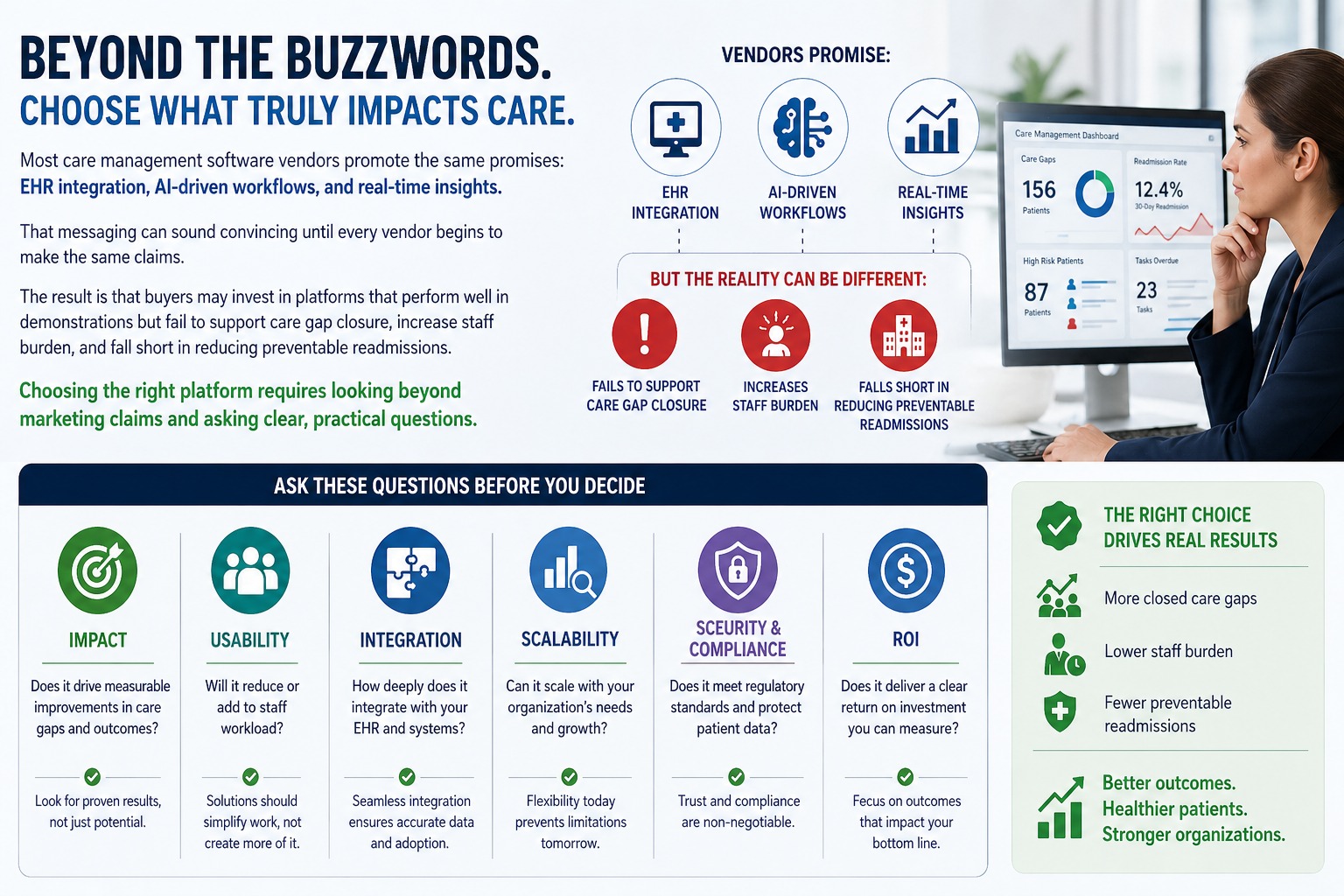
Most care management software vendors promote the same promises: EHR integration, AI-driven workflows, and real-time insights. That messaging can sound convincing until every vendor begins to make the same claims. The result is that buyers may invest in platforms that perform well in demonstrations but fail to support care gap closure, increase staff burden, and fall short in reducing preventable readmissions. Choosing the right platform requires looking beyond marketing claims and asking clear, practical questions.
EHR Integration: The Most Overused Claim in Healthcare Tech
Almost every vendor will tell you they integrate with your EHR. What they do not volunteer is what is actually done by that integration. There is a major difference between a platform that only reads data and one that supports real-time, bidirectional exchange.
Questions that cut through the noise
- Is the integration bidirectional, or does data only flow one way?
- Does the platform use HL7 FHIR APIs, or is it dependent on manual file exports?
- How frequently does data refresh in real-time, hourly, or an overnight batch?
- Which specific EHR systems have live, deployed integrations, not just listed compatibility?
Strong integration should support the consolidation of clinical, claims, device, patient-reported, and social determinants data into a unified longitudinal patient record. That level of integration provides the foundation needed for reliable point-of-care decisions.
AI in Care Management: Substance vs. Label
“AI-driven” has become a standard claim rather than a meaningful differentiator. Before accepting the claim, ask the vendor to show you what the AI specifically does inside their platform, not in theory, but in a live workflow.
What real AI should do
- Risk stratification: Combines clinical, claims, and SDOH data to flag high-risk patients proactively, before deterioration occurs
- NLP on unstructured data: Reads physician notes and discharge summaries to surface insights that structured fields never capture
- Automated care gap identification: Specific to each value-based care program (not generic reminders pushed to everyone)
- Workload reduction: Measurable decrease in time spent per patient
Vendors should be able to demonstrate measurable clinical logic, configurable care pathways, and evidence that their AI capabilities reduce manual workload.
Workflow Fit: The Factor That Determines Adoption
Even the most feature-rich platform provides little value if clinicians do not use it consistently. Adoption hinges on the fit of the software to existing workflows, rather than the extent to which it requires teams to change their behavior.
Signs of genuine workflow integration
- Care plans auto-generate from patient data and are configurable
- Clinical interventions surface at the point of care, inside the encounter
- Resource prioritization helps care teams focus efforts on the highest-risk patients.
- Multi-channel communication (text, audio, video) and telehealth are inherent, rather than third-party features.
Patient Engagement Beyond the Portal
A patient portal is not patient engagement, but access. Effective patient engagement means reaching patients through accessible channels and responding quickly to changes in their health status.
What to look for
- AI-guided assessments that adapt dynamically based on patient responses
- Automated outreach triggered by clinical events or risk score changes
- Two-way messaging across text, audio, and video, accessible from any device
- Patient-reported data feeding back into the longitudinal record automatically
Outcome Claims: How to Verify Before You Buy
Vendors will cite impressive numbers. Your job is to pressure-test them before they influence your decision.
| What vendors show | What you should ask for |
| Readmission rate reduction | Methodology, population type, measurement period |
| Provider workload reduction | Time-motion data or before/after workflow studies |
| Cost savings | Total cost of care tied to a specific program |
| Care gap closure rates | Baseline rates, program context, timeframe |
Verified outcome metrics, such as reductions in 30-day readmissions, provide meaningful evidence of platform performance. As a vendor makes such a claim, request the case study, the population, and the period.
Takeaway
Deciding on a care management software implies the verification of actual clinical performance and not features only. Focus on vendors that demonstrate strong interoperability, workflow alignment, and measurable clinical outcomes. Platforms like CareSpace® that combine these capabilities are more likely to deliver sustainable value.