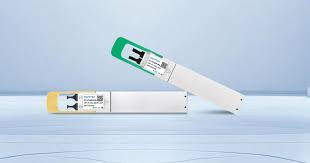
Introduction: The Next Leap in Optical Interconnects
The relentless growth of cloud computing, AI-driven workloads, and ultra-high-definition content has accelerated the demand for faster optical transmission within and between data centers. To meet these needs, the OSFP (Octal Small Form-factor Pluggable) module has emerged as one of the most powerful solutions for next-generation high-speed networking. Designed to support bandwidths of 400G, 800G, and even 1.6T, OSFP transceivers combine compact design, energy efficiency, and scalability to address the most demanding data center architectures.
What Is an OSFP Transceiver?
An OSFP transceiver is a hot-pluggable optical module that supports eight electrical lanes, each capable of 50G, 100G, or even 200G depending on the version. Unlike older formats such as QSFP28 or QSFP-DD, OSFP is slightly larger but offers superior thermal performance and power capacity—enabling transmission beyond 400G without cooling constraints. It was designed to be backward-compatible with QSFP infrastructure through appropriate adapters, providing an easy path for network upgrades.
Evolution of OSFP Technology
The OSFP standard was introduced to meet the 400G Ethernet generation’s needs. However, as cloud platforms began scaling faster than ever, OSFP evolved into 800G and eventually 1.6T capable solutions. This evolution involved improvements in PAM4 modulation, low-loss materials, better thermal dissipation design, and advanced DSP (Digital Signal Processing) chips.
Here’s a quick look at the generational progression:
- 400G OSFP: Typically based on 8 × 50G PAM4 lanes.
- 800G OSFP: Utilizes 8 × 100G PAM4 lanes, doubling throughput.
- 1.6T OSFP: The latest version, supporting 8 × 200G, is paving the way toward the next generation of AI and cloud networking.
400G OSFP vs. QSFP-DD: Bridging Generations
While both OSFP and QSFP-DD can deliver 400G performance, they serve slightly different roles. 400G QSFP-DD (Quad Small Form-factor Pluggable Double Density) is widely used today because of its familiarity and mechanical backward compatibility with QSFP28. For example, modules like the QSFPTEK are ideal for medium-reach (2 km) data center links that need reliable performance and modest power consumption.
However, as optical links begin to extend across clusters or between massive AI training pods, OSFP’s advanced thermal management and higher power ratings (up to 16 W per module) make it better suited for expansion into 800G and 1.6T networks. Essentially, QSFP-DD covers the present, but OSFP defines the future.
Inside OSFP: Key Design Features
- High Power Capacity:
OSFP modules can handle up to 15–16 W, enabling support for advanced DSPs and long-reach optics. - Superior Heat Dissipation:
The slightly larger size allows more efficient airflow and better thermal coupling between the module and heat sink—critical for dense AI servers and switches. - Enhanced Electrical Interface:
Support for 8 high-speed lanes simplifies scaling from 400G to 800G and beyond without changing the connector footprint. - Adaptability:
With physical adapters, OSFP ports can still interface with QSFP-DD modules, ensuring seamless transitions in multi-generation networks.
Application Scenarios for OSFP Transceivers
- Intra-Data Center Links: High-density top-of-rack (ToR) and spine switches running 400G or 800G Ethernet.
- Inter-Data Center Connections: Long-reach optics over single-mode fiber for hyperscale campus deployments.
- AI Clusters and HPC Environments: 800G–1.6T OSFP modules offer massive data throughput required for GPU and TPU-based processing nodes.
- Telecom Core and Metro Networks: Low-latency, high-bandwidth transport for 5G and edge computing.
OSFP 400G, 800G, and 1.6T: Use Cases and Reach
| Variant | Lanes | Typical Reach | Wavelength Type | Use Case Example |
| 400G OSFP-DR4 | 8×50G | up to 500m | 1310 nm | Rack-to-rack links |
| 800G OSFP-2xFR4 | 8×100G | up to 2 km | CWDM4 | AI/ML clusters |
| 1.6T OSFP-LR8 | 8×200G | up to 10 km | LAN-WDM | Long-reach DCI |
Each generation simultaneously improves module density and network bandwidth efficiency. For hyperscale data centers, 1.6T OSFP reduces port count and operational cost while significantly boosting aggregate throughput.
Why OSFP Is the Future of High-Speed Connectivity
The OSFP form factor represents a convergence of scalability, cooling efficiency, and long-term adaptability. As Ethernet standards continue moving toward 1.6T and 3.2T, OSFP’s mechanical and electrical design provides the flexibility to scale without redesigning entire switch platforms. Its readiness for co-packaged optics (CPO) and active optical cables (AOCs) ensures long viability even as network architectures evolve.
Moreover, OSFP modules are gaining strong industry support from leading vendors, ensuring broad interoperability and cost competition, two factors critical for large-scale deployment.
Conclusion: Investing in Scalable Optical Infrastructure
OSFP transceivers mark a new era in optical communication, unifying performance and practical design for data centers driving the world’s digital ecosystem. Whether deploying 400G connections with QSFP-DD 400G FR4 or planning the shift toward 1.6T OSFP, organizations are laying the foundation for a scalable and efficient future.
In an era where cloud, AI, and edge services expand exponentially, OSFP stands as the cornerstone technology for next-generation high-speed networks—bridging today’s infrastructure with tomorrow’s innovation.